Reconfifigurability of integrated photonic chips plays a key role in current experiments in the area of linear-optical quantum computing. We demonstrate a reconfifigurable multiport interferometer implemented as a femtosecond laser-written integrated photonic device. The device includes a femtosecond laser-written 4×4 multiport interferometer equipped with 12 thermooptical phase shifters, making it a universal programmable linear-optical circuit. We achieve a record fast switching time for a single nested Mach-Zender interferometer of 10 ms and quantitatively analyse the recon- fifigurability of the optical circuit. We believe, that our results will improve the current state of quantum optical experiments utilizing femtosecond laser-written photonic circuits.
The quest for building a large-scale linear optical quantum computer implies the development of miniature, stable and precise optical components. A remarkable success of the microelectronic industry proves the immense effiffifficiency of integrated device fabrication and dictates the future trend for quantum photonic device engineering. Since the pioneering work an integrated photonic approach fifirmly keeps the leadership in precision quantum optical experiments , optical quantum computing and quantum simulation. Recent works have also demonstrated the potential of adopting standard silicon photonic technologies for quantum applications, ensuring compatibility with modern CMOS fabrication lines.
Along with stability and precision, the integrated photonic technology provides a toolset for reconfifigurable circuit fabrication, endowing the experimenter to perform numerous experiments with a single device. Recently quantum computing experiments have been demonstrated on reconfifigurable platforms, proving their potential for realizing completely difffferent experimental settings with a single device . Reconfifigurability provides enough freedom to augment linear optical quantum computing experiments with machine learning algorithms, paving the way to more sophisticated applications for the devices of increased complexity.
Recently the femtosecond laser writing technology (FSLW) has established itself as a flflexible tool for rapid prototyping of integrated photonic circuits, which is especially valuable for laboratory experiments, where the fabrication time is crucial. FSLW provides low-loss waveguide writing regimes for a wide variety of wavelengths from the visible to the telecom range . Waveguide fabrication is possible in glasses, crystals, nonlinear materials, etc. FSLW enables polarization state manipulation capabilities and essentially 3D waveguide circuit design . The FSLW technology in the current quantum optical scope provides a versatile tool to process complex quantum states of light encoded in difffferent degrees of freedom on the integrated photonic platform. For example, it has been applied for characterisation of hyperentangled path-polarization states, and further development of the active FSLW technology may significantly contribute to the on-chip manipulation of such states. One of the key advantages of this technology in comparison with lithography is its flflexibility and very fast and inexpensive technological process.
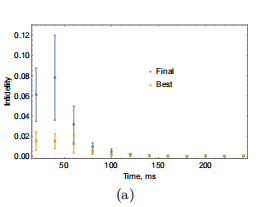
Fig1
To test the reconfifigurability of the device we performed a series of optimization procedures – tuning the device to operate as a switch, redirecting all the light from a given input port to a given output port, and tuning it to randomly selected target intensity distributions. The results are shown in the Fig. 3(c) and Fig. 3(b), correspondingly. On average, fifinding the heater confifiguration corresponding to a randomly generated pattern turned out to be an easier task in our experimental setting due to the lower sensitivity to the background intensity collected by the output multimode fifiber array.
We presented our results on fabrication of a programmable multiport integrated optical circuit with the femtosecond laser writing technology. Our work demonstrates the possibility to produce fully-reconfifigurable interferometers with superior switching times – 10 ms switching time – an order of magnitude faster compared to all previously reported results. We have characterized the reconfifigurablity of the device using the classical input light and developed an adaptive procedure to tune the circuit in accordance with the desired confifiguration. Further developments should be dedicated to refifining the device performance to meet the required precision to operate in quantum regime, i.e. to set arbitrary unitary transformations with high fifidelity. This goal requires better localization of the heated chip areas to reduce the crosstalk effffects and enhancement of the directional coupler fabrication repeatability. However, even with the current level of performance a reconfifigurable circuit of such complexity is a signifificant step forward for the FSLW technology. We believe that the techniques developed in this work will be used to enable fast and inexpensive fabrication of integrated photonic circuits specififi- cally tuned for particular experiments right in the optical laboratory. Fully reconfifigurable integrated circuits are prerequisites for modern experiments in quantum optics and linear-optical quantum computing. Thus the results presented in this work may boost the research in this rapidly developing fifield.
上一篇: 金刚石拉曼激光器
下一篇: 第三代红外光子探测器的竞争技术