Synthetic single-crystal diamond has recently emerged as a promising platform for Raman lasers at exotic wavelengths due to its giant Raman shift, large transparency window and excellent thermal properties yielding a greatly enhanced figure-of-merit compared to conventional materials. To date, diamond Raman lasers have been realized using bulk plates placed inside macroscopic cavities , requiring careful alignment and resulting in high threshold powers (~W-kW). Here we demonstrate an on-chip Raman laser based on fully-integrated, high quality-factor, diamond racetrack microresonators embedded in silica. Pumping at telecom wavelengths, we show Stokes output discretely tunable over a ~100nm bandwidth around 2-μm with output powers >250 μW, extending the functionality of diamond Raman lasers to an interesting wavelength range at the edge of the mid-infrared spectrum. Continuous-wave operation with only ~85 mW pump threshold power in the feeding waveguide is demonstrated along with continuous, mode-hop-free tuning over ~7.5 GHz in a compact, integrated-optics platform.
The availability of CVD-grown, high-quality polished, single-crystal diamond plates has enabled the development of bulk Raman lasers using macroscopic optical cavities across the UV, visible, near-infrared and even mid-infrared regions of the optical spectrum. Although showing great performance with large output powers (many Watts) and near quantum-limited conversion efficiencies , most operate in pulsed mode in order to attain the very high pump powers required to exceed the Raman lasing threshold Demonstration of continuous-wave diamond Raman lasing has been challenging, with very few reports . Bulk cavity systems also require precise alignment and maintenance of optical components for the laser to function robustly.
Diamond can potentially overcome these drawbacks and has recently emerged as a novel nanophotonics material with applications in integrated, on-chip quantum and nonlinear optics . Diamond’s large bandgap of ~5.5 eV and lack of Reststrahlen-related absorption at low frequencies affords it a wide space for creating high quality factor resonators. Here we demonstrate the first CW, tunable, on-chip Raman laser operating at ~2-μm wavelengths using telecom-laser-pumped high-Q, waveguide-integrated diamond racetrack resonators embedded in silica on a silicon chip.
In conclusion, we have demonstrated a CW, low-threshold, tunable, on-chip Raman laser operating at ~2-μm wavelengths based on waveguide-integrated diamond racetrack microresonators. The threshold power is limited by the severe under-coupling of the bus waveguide to the resonator, and could be further reduced by moving to near critically-coupled modes for the pump. This can be easily achieved, for example, by slightly reducing the coupling-gap between the bus-waveguide and resonator. The external conversion efficiency can also be drastically increased by having over-coupled resonances for the Stokes in addition to critical-coupling for the pump, and this should naturally happen in the current design if the intrinsic Qs of the pump and Stokes mode are of the same order. Longer coupling sections and other coupling designs can also be investigated . Further improvement can be made by having higher intrinsic Q and/or smaller FSR (to ensure maximum Raman gain) i.e. longer path-length resonators. Another limiting factor comes from the orientation of the diamond itself. Our devices are fabricated inoriented diamond, and the pump and Stokes mode are both TE polarized, where Raman gain is sub-optimal and there is no polarization preference for the Stokes. By ensuring that the light polarization is parallel to <111>, for example using angle-etched resonators in thick diamond plates, the efficiency of the Raman process can be enhanced . Further, by moving to an all-diamond structure, the resonator should be able to support more circulating power and reach higher output powers while also offering a route toward longer-wavelength/cascaded Raman lasers, where the absorption of silica would limit performance otherwise. Nonetheless, the current platform already offers a large amount of flexibility, with the option to fabricate devices at visible wavelengths, where the Raman gain is ~20x higher. Operation in the visible would enable integration of classical nonlinear optics technologies (Raman lasing, Kerr frequency combs) with the quantum optics of color centers.
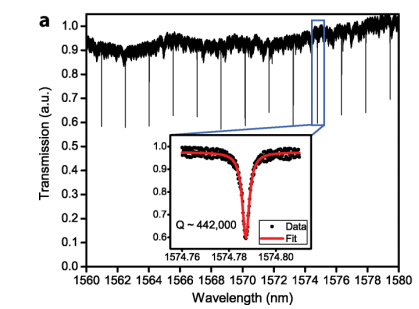
Fig1
Transmission spectrum of the diamond racetrack resonator at telecom (pump) wavelengths taken by sweeping a continuous-wave laser reveals high-Q transverse electric (TE) modes with 30-40% extinction ratio (under-coupled resonances). The path length of the resonator is ~600 μm, corresponding to an FSR of ~1.5 nm (~180 GHz). Inset: A loaded Q of ~440,000 is inferred from the Lorentzian fit to the mode at ~1574.8 nm. b, , Transmission spectrum of the diamond resonator at the Stokes wavelength range near ~2-μm (~40 THz red-shifted from the pump) taken using a broadband super-continuum source again reveals high-Q TE modes with 30-40% extinction ratio (under-coupled resonances). Inset: A loaded Q of ~30,000 is inferred from the Lorentzian fit to the mode at ~1966 nm, although this may be limited by the resolution (~0.056 nm) of our optical spectrum analyzer.
下一篇: 玻璃芯片上的可重构光子学