Research related to semiconductor devices often relies on wafer fabrication. The fabrication of Silicon (Si) based devices by anisotropic wet etching can be affected by many etching parameters such as etching temperature, crystal orientation and percent of composition. Most of the anisotropic wet etchings by KOH solution done before were conducted at temperature over 70°C. We found that the temperatures are not suitable to fabricate ring waveguide as the waveguide wall will collapse at such high temperature. This study reports the etching characteristics of Si <100> in KOH solution with 35% concentration at the temperature below 70°C. The etched wafer is targeted to be the basic structure for Microring Resonators (MRRs) based devices. This technique provides not only lower cost as compared to other etching technique, but also simple preparation. We found that low temperature manage to mold a good ring waveguide with low tendency to form rectangular structure due to crystal orientation. At 40°C, the best waveguide formation was obtained with a smooth waveguide surface, experiencing an etching rate of 0.066 µ min−1 and an appreciable ring waveguide structure. The effect of the low temperature on the fabrication of the MRRs devices has been investigated and studied.
Microring Resonators (MRRs) are of great interest for integrated optoelectronic applications due to a number of reasons; compact size, simple design and high wavelength selectivity. Its application in diverse field such as optical communications system, biochemical sensing and laser systems make it a prime selection in the design of optoelectronic devices. Among the devices that can be designed using the MRRs is filters, modulators and delay line (Hazura et al., 2010; Shaari et al., 2010). Most of these devices can be realized by optical waveguides where it forms the basic structure for device construction. The simplest configuration of a MRRs device consists of one straight waveguide and one circular waveguide, also known as ring resonator as shown in Fig. 1. This configuration is commonly used in MRRs filter. The rib waveguide width for the circular waveguide, WR and the straight waveguide, WS designed in this study are 4µm and the gap distance between the straight and circular waveguides is 1 µm.
If Eq. 1 is not satisfied, the microring will as a condition known as OFF resonance. At OFF-resonance state, the guided wave will bypass the ring and emitted at the output port. Upon the occurrence of resonant, the guided wave in the bus waveguide will be coupled to the ring and eventually the power observed at the output port will be depleted. This condition can be explained from the simulated result obtained from commercially available software by RSoft Inc. as presented in Fig. 3.
To ensure the functionality of MRRs, both two waveguide structures must be formed properly. Fabrication of these devices on single-crystal Silicon (Si) wafer can be implemented using three main methods; wet etching, dry etching and laser writing.
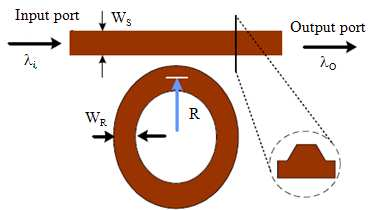
Fig1
To ensure the functionality of MRRs, both two waveguide structures must be formed properly. Fabrication of these devices on single-crystal Silicon (Si) wafer can be implemented using three main methods; wet etching, dry etching and laser writing.
Depending on the applications and specifications of the proposed device, each method has its own advantages and disadvantages. Fabrication based on anisotropic wet etching was selected in our study because of low cost factor and easy preparation.
There are many research has been conducted previously to understand KOH wet etching, but most study performed at high temperature (over 60°C) (Canavese et al., 2007). The purpose of this study is to discuss the characterization and the main issues arising in the Si waveguide fabrication process in the construction of MRRs device. Our focused is on the fabrication of MRR on Si using KOH wet etching at temperatures close to room temperature.