This work is dedicated to developing a method of combined surface morphology- and crystallographic analysis for crystalline silicon. To demonstrate the applicability of the method, a seriesof chemical operations, such as polishing and texturing, were applied to multi-crystalline siliconsamples. The samples were pre- and post-analysed with WLI and Laue techniques, and the experimental data allowed construction of maps for crystal orientation to etching rate dependency.The study illustrates the strengths of the combinatory technique as an alternative to existingtechniques such as atom force microscopy (AFM) and electron backscatter diffraction (EBSD).
The modern semiconductor silicon industry and research domains connected to this industry use a wide range of surface analysis techniques to study crystal structure, -orientation, -morphology, -grain structure and -2d defects (grain boundary, twins, etc.).Common techniques include scanning electron microscopy (SEM) [1], atomic force microscopy (AFM) [2,3] and electron backscatter diffraction (EBSD) [4]. The crystalline silicon surface properties and crystallography are important as they largely affect the efficiencyof solar cell processing operations such as texturing, polishing and etching conducted on the surface.
Scanning techniques such as stylus profilometry [3] and AFM are important techniques for “direct” surface scanning. Stylusprofilometry is one of the widely used instruments for surface morphology measurements because of its simple working principlewhich is based on the conversion of a mechanical response to electrical signal. This technique can be used for relatively large sampleareas up to 300 mm. However, the lateral resolution of this technique is limited to maximum 50 nm. In the modern silicon industry,morphological processing on Si has a nano-meter scale and to observe morphological changes in porosity [5], nano-columns [6] etc.,more precise techniques are hence required.
First, the sample is placed onto the stage (Fig. 2). Second, the Laue stage is moved in the Z-direction to set an optimal distancebetween scanner and sample. The scanning procedure of the Laue tool can be divided into 2 modes, which are i) optical and ii) X-ray(Laue) scan. During the optical mode scanning, the sample surface is illuminated with the white light and scanned by the built-inmicroscope, in order to distinguish different grains on the sample. All detected crystal grains are subsequently scanned by the X-ray,to obtain backscatter diffraction of the present lattices. As a result, all crystal orientations are measured and the hkl colour map ofthe sample is created.
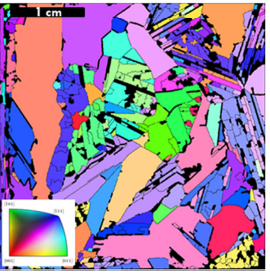
Fig1
The scanning process by the WLI consists of light beam emission onto the Mirau interferometer [12] and the surface of thespecimen. The interface fringes created by the combined reflected beams are analysed by a charge-coupled device (CCD) camera[12]. A detailed scanned image of the surface height along the scanning axes is obtained by constructing fringes along the scanningrange. Moreover, a cross-action mode might be useful and precise for a determination of the height difference between grains on asample.
上一篇: 磷酸蚀刻增强纳米坑TiO 2表面亲水性