Integration of graphene with Si microelectronics is very appealing by offering a potentially broad range of new functionalities. New materials to be integrated with the Si platform must conform to stringent purity standards. Here, we investigate graphene layers grown on copper foils by chemical vapor deposition and transferred to silicon wafers by wet etching and electrochemical delamination methods with respect to residual submonolayer metallic contaminations. Regardless of the transfer method and associated cleaning scheme, time-of-flight secondary ion mass spectrometry and total reflection X-ray fluorescence measurements indicate that the graphene sheets are contaminated with residual metals (copper, iron) with a concentration exceeding 1013 atoms/cm2 . These metal impurities appear to be partially mobile upon thermal treatment, as shown by depth profiling and reduction of the minority charge carrier diffusion length in the silicon substrate. As residual metallic impurities can significantly alter electronic and electrochemical properties of graphene and can severely impede the process of integration with silicon microelectronics, these results reveal that further progress in synthesis, handling, and cleaning of graphene is required to advance electronic and optoelectronic applications.
Graphene has a great potential to provide a performance boost for the next generation of highfrequency electronic and photonic devices. In view of these applications, chemical vapor deposition (CVD) on metal surfaces is currently one of the most relevant graphene synthesis techniques delivering large-area and good-quality material.8 Practical use of transferred CVD graphene in electronic and photonic devices will likely require a co-integration of the new material with the existing semiconductor device manufacturing platforms. For example, CVD graphene will have to comply with very stringent purity standards. A large research effort has been dedicated so far to study residual polymer impurities resulting from graphene transfer.8 Significantly less attention has been paid to potential submonolayer metallic contamination of graphene associated with the growth on and transfer from metal catalysts, such as Cu or Ni. Since trace impurities in silicon can result in detrimental effects on the performance of electronic devices, detection and control of metal contaminants in Si-integrated circuit manufacturing are of critical importance to achieve high product yield. The effects of metal contamination (e.g., Cu, Ni, Fe) include junction leakage current increase and lifetime and dielectric strength degradation.9 Even at very low concentrations (1010 1011 atoms/cm2 ), trace metals pose a serious threat to Si devices.10 Since CVD graphene is usually synthesized on metallic surfaces, the growth and transfer processes can potentially cause residual contamination of graphene sheets. Although graphene is reported to be an effective barrier against Cu diffusion,11 residual Cu atoms from contaminated graphene can potentially out-diffuse toward the substrate in the course of further device processing and result in degradation of device parts located beneath graphene. This can be expected based on the ability of Cu atoms (ions) to diffuse (drift) through dielectrics under thermal or electrical stress. Residual metals released during device processing can also cause cross-contamination of sensitive manufacturing tools. Finally, it has been demonstrated that residual metallic impurities can significantly alter electronic and electrochemical properties of graphene. It has been also shown that, even if nuclear purity graphite is used as the source material for graphene synthesis, the latter can be contaminated with impurities originating from chemical reagents used for processing.
The quality of the transfer process for each sample was controlled with optical microscopy (OM) and Raman spectroscopy. Figure 1a,b shows OM images of graphene layers transferred onto 300 nm SiO2/Si using wet etching and electrochemical delamination. Figure 1c shows the corresponding representative Raman spectra. In general, both transfer techniques result in good-quality graphene with a low amount of cracks and holes and a low-intensity Raman D band (see also Supporting Information, Figures S1 and S2). For ToF-SIMS measurements, the 1x1 cm2 graphene patches were inspected with OM and Raman spectroscopy and the areas with the best quality (i.e., low amount of holes and particles, low Raman D band) were selected for further investigation.
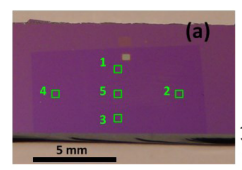
Fig1
Figure 5 presents results obtained for optimized transfer and cleaning protocols, thus constituting the cleanest graphene samples obtained in this work on 200 mm wafer substrates. Here, APS was used to etch Cu foil, and the PMMA/graphene stack was rinsed several times in DI H2O. Subsequently, samples were placed in a HCl-based cleaning solution to remove metallic residuals from graphene. Finally, graphene with PMMA was moved to a large volume container with DI H2O and transferred to the target wafer. Special care was taken to eliminate all metallic tools (tweezers, scissors, etc.) from the transfer process. The concentration of Cu in the neighborhood of the graphene patches (indicated by arrow, S) is below the detection limit (BDL), indicating that the process does not contaminate the wafer with Cu beyond areas covered with graphene (for example, by redeposition during the fifinal rinsing step). At the same time, the concentration of Cu impurities on the areas covered with graphene stills exceeds 1 x10¹³ atoms/cm2 . Moreover, signififi- cant amounts of Fe residuals are found both on graphene and on the uncovered SiO2 surface.