The convergence of Micro Electro Mechanical Systems (MEMS) and optics was, at the end of the last century, a fertile ground for a new breed of technological and scientifific achievements. The weightlessness of light has been identifified very early as a key advantage for micro-actuator application, giving rise to optical free-space MEMS devices. In parallel to these developments, the past 20 years saw the emergence of a less pursued approach relying on guided optical wave, where, pushed by the similarities in fabrication process, researchers explored the possibilities offered by merging integrated optics and MEMS technology. The interest of using guided waves is well known (absence of diffraction, tight light confifinement, small size, compatibility with fifiber optics) but it was less clear how they could be harnessed with MEMS technology. Actually, it is possible to use MEMS actuators for modifying waveguide properties (length, direction, index of refraction) or for coupling light between waveguide, enabling many new devices for optical telecommunication, astronomy or sensing. With the recent expansion to nanophotonics and optomechanics, it seems that this fifield still holds a lot of promises.
The birth of integrated optics, and more exactly the start of the technology enabling optical waveguide fabrication, may be traced back to the fifine team of researchers at Bell’s Lab at the end of the 60s. In fact, the seminal work appeared in a special issue of the Bell System Technical Journal in 1969, and proposed technologies and theories for fabricating and modeling waveguides, opening the path to what is now known as integrated optics.
It is rather eye opening to realize that the start of the MEMS technology, which enables fabrication of mechanical elements and actuators with microelectronics-like microfabrication techniques, dates back to the same era. In 1965 a team of researchers at Westinghouse research labs developed the resonant-gate transistor that showed a remarkable integration of mechanical resonator with a fifield-effect transistor. Still, from this early work, the MEMS technology had to wait for the late 1980s to bloom, and actually the term MEMS itself was only coined in 1989 by Professor Howe at a notorious MEMS conference.
It was only a matter of time before these two technologies would converge and at the beginning of the 1990s, several research groups in Asia , Europe and America proposed to use MEMS actuator with waveguide for a large range of different devices, from simpler sensors to optical telecommunication switches. Researchers have over the years explored different paths for building those devices where a MEMS actuator is able to modify the propagation of the light in a waveguide. Currently we can identify four simple principles schematically depicted in Figure 1. One of the fifirst principle explored (Figure 1a) was based on changing the coupling between fifixed waveguides using a MEMS actuated mirror and, for example, could be used for optical switch fabrication. In this review, we will only consider the devices based on co-integration of waveguide and MEMS and will not discuss the other interesting devices based on optical fifiber integration with MEMS actuator. Similarly, directly changing the direction of a waveguide (Figure 1b) is a powerful method to channel the light between different waveguides. Then, it is possible to change the propagation of the wave in the waveguide, either by interacting with the optical fifield outside the waveguide (Figure 1c) or by directly modifying the refractive index of the material by inducing longitudinal strain (Figure 1d).
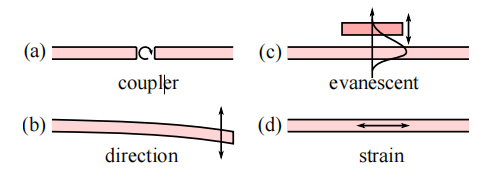
Fig1
The question may arise, why in the fifirst place would we want to use mechanical actuation whereas integrated optics has its own way of modifying light propagation in waveguides. Electro-optic, acousto-optic, and thermo-optic effects or the injection of free-carrier in semi-conductors are all very effificient principles for changing the index of refraction of materials, hence opening fabrication of high-speed or complex optical circuit for telecommunication or sensing. If they are fast—much faster than MEMS actuator—these principles, rooted in material properties, have very little magnitude (change of index of refraction in the 10−3 range) and in classical devices needs relatively long distance (cm) to obtain useful effects. Although photonic crystals devices using slow light may be very small, a need for a compact integrated optics technology remains. It can defifinitely be achieved with MEMS actuators as the effect of moving optical elements is stronger than material effects. Moreover, the ability to act on the waveguide itself, changing its direction or length, opens-up new possibilities by allowing action principles previously impossible, potentially providing a new paradigm for photonics.
From the early days, an important issue of this new technology remains the co-integration of optical waveguide and MEMS actuator. Simple sensing devices, where the actuation energy actually comes from the environment (vibration, pressure, acceleration, etc.), were from the beginning fully integrated but it proved more diffificult when the was actuator powered internally. In fact, among the fifirst devices developed most used crude integration and only the group of Voges at TU Dortmund in Germany proposed a complete co-integration process. However, in our view, the co-integration is an important enabling technology that would allow building of array of devices (e.g., switch or sensor array), facilitate batch fabrication, limiting assembly and ultimately lower the cost.
上一篇: 基于MEMS的不同类型的谐振器